
Written by Manon Carrere
Meta promises you to connect you to the ‘people and things you love’. Social media has become infrastructure. Most of us do not experience social media as one thing: we can use it to stay informed, communicate, or find forms of community that may be harder to access offline. While it can make us feel connected, it can also leave us feeling strangely detached. As Judith Zoë Blijden, creator and host of The Digital Period, says in the episode: ‘Sometimes scrolling makes me feel more detached while being fed content that I hate.’
The new season of The Digital Period is produced in collaboration with the ReSocial project. It examines what social media does (or do) to the way we relate to ourselves, to others, and to public life.
At the centre of the season is one question: ‘Are social media platforms actually social? And if not, what can we do about it?’
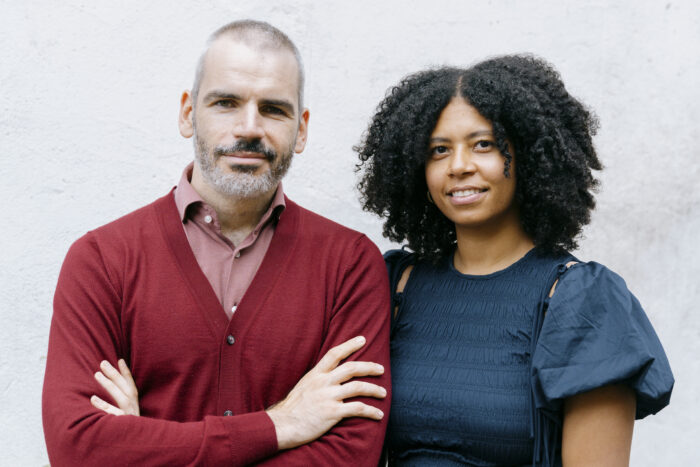
For this season, prof. dr. Gianclaudio Malgieri, project leader of the RESOCIAL project joins Judith as a co-host. Together they interview the guests of the season. In this first episode Gianclaudio re-introduces two concepts that will be central in this new season: vulnerability and resilience. RESOCIAL studies these questions from different angles, including law, human-computer interaction and social research, with a focus on how people are exposed to harm online.
‘Sometimes scrolling makes me feel more detached while being fed content that I hate.’
Why talk about social media now?
Social media changed. In the last two years, tech companies abandoned most of their ethical narratives. Quickly, they are letting go of some of the safeguards. In addition, the growing role of generative AI is adding a new layer to the problems of social media. The studies relating to the societal and pschychological harms of social media have been piling up. These developments have not gone unnoticed. Government throughout the world are trying to mitigate the harmful effects of social media. In October the European Commission will propose a new law proposal for the Digital Fairness Act that is promised to address the harms of social media.
We might be on the edge of a change of how social media. Therefore the perfect time to discuss social media is now.
This season will feature researchers, policymakers, civil society voices, and people who use social media, chose to stop using it, or have never used it at all.
The value of social media
Ofcours social media is not only harmful. For many users, these platforms have opened forms of connection that would otherwise be difficult to access. This was the case for both Gianclaudio and Judith. Gianclaudio recognizes that, as a queer person in southern Italy, social media was helpful to find others and feel less alone. It allowed “affinity to flourish beyond physical space”. For Judith social media has been a way she could give visibility to The Digital Period, through which she has met many wonderful people across the world.
What does vulnerability mean online?
The concept of vulnerability is often seen as a list of groups of people considered particularly at risk. Such as children, migrants or persons with disabilities. However, it is more than that. Gianclaudio defines vulnerability as a “higher exposure to harm”, which in legal terms means a higher risk to fundamental rights. That exposure depends on the relationship between a person and a more powerful actor, as well as on the safeguards, inequalities, and social conditions around that relationship.
Social media is one of the places where these relationships have become visible. It is no longer only a space for entertainment or communication; it has become part of the infrastructure of everyday and public life. It shapes how we see ourselves, how we relate to the people around us, and how we understand our shared reality. Gianclaudio describes it as a place where “everything happens”. This makes it important to be able to exercise our fundamental rights, while also raising difficult questions about ownership, design, commercial interests or accountability.
Resilience as a collective effort
The other relevant concept is resilience. The term often places too much weight on the individual. This implies that users should simply become more informed or careful in order to manage risks that are largely produced around them. But within the ReSocial project, resilience is reconceptualised as something broader: “resilience is not only and not especially a personal thing. It’s a collective effort.” That collective effort depends on the support people have around them, from communities and healthcare systems to public institutions, regulation, the design of technology and the rule of law. This support should help people resist or avoid harm, instead of leaving them to manage it on their own. A safer digital environment cannot depend only on individual users making better choices inside systems they did not design.
New episodes will be out every other week on Tuesdays starting the 15th of September.
- Episode 1 | Why we want we need to talk about social media
- Episode 2 | Beyond the ban: youth and digital resilience with Esther Rozendaal, Professor of Digital Resilience at Erasmus University Rotterdam, and Flemish youth representatives Lore Sleerx and Reinout Vermaercke.
- Episode 3 | Platform Politics with Kim van Sparrentak
- Episode 4 | The limits of personal resilience with Maria-Lucia Rebrean, PhD researcher at Leiden University
- Episode 5 | Manipulative design with dr. Lorena Sánchez Chamorro, postdoctoral researcher at the University of Twente
- Episode 6 | Community and Power with dr Itxaso Domínguez de Olazábal, policy advisor at European Digital Rights (EDRi) and Esra Karakaya
- Episode 7 | Reclaiming agency with Rejo Zenger, policy advisor at Bits of Freedom and Paola Verhaert, writer and digital rights expert
- Episode 8 | forthcoming…
Listen to The Digital Period podcast wherever you listen to podcasts.
https://thedigitalperiod.podbean.com/
Subscribe to our newsletter!
Stay up to date:
www.thedigitalperiod.com/newsletter
www.instagram.com/thedigitalperiod
https://www.linkedin.com/company/the-digital-period